.webp)
Evidence and professional information on NAROVAC
This section provides veterinary and animal-health professionals with a concise overview of NAROVAC and links to the published research supporting its development and field evaluation.
Scope notice: Final technical guidance, including dosage, schedule, storage, indications, contraindications and administration, must be supplied and approved by the authorized technical and regulatory reviewers.
Mechanism of action
NAROVAC is based on vaccination against selected tick antigens. Vaccinated cattle develop circulating antibodies that are ingested by attached ticks during feeding. Within the tick, antibody interaction with targeted proteins can disrupt biological functions associated with feeding, digestion, survival and reproduction.
The intended population-level effect is a reduction in tick fitness and reproductive capacity over time. Readers should consult the linked publications for study design, endpoints, limitations and detailed findings.
.webp)
Field evaluation
Subolesin-based anti-tick vaccination has been evaluated in Ugandan field studies involving multiple sites, agro-ecological conditions, cattle breeds and tick species. Published work has examined vaccine safety, effectiveness, protection against tick infestation and the broader role of vaccination in integrated tick control.
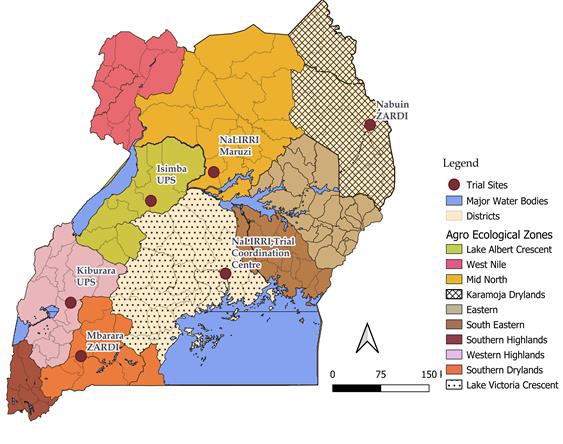
Review the PublicationsLocation of experimental cattle sites and reasons for their selection
Trial sites are spread across Uganda's agro-ecological zones (AEZs) so that the vaccine is evaluated under genuinely different field conditions. Six criteria guide the selection of each site.
-
1.
Agro-ecological zones: At least two sites, as required by the NDA ecto-parasitocide regulation.
-
2.
Cattle breeds: EASZ, Boran and Ankole breeds, matched to the conditions of each site.
-
3.
Tick species: Abundance, burden, challenges and distribution recorded at each site.
-
4.
Availability of cattle: Cattle available for 365 days to support continuous evaluation.
-
5.
Institutional farms: Reduced-cost platforms for disseminating research findings.
-
6.
Trial design: International vaccine trial designs followed for robust evidence.
Approved professional guidance
The schedule below is the vaccination regime used in the trials. Always confirm the regime for each herd with the responsible veterinary professional.
Anti-tick vaccination within integrated tick control
The vaccine performs best when it is used as one part of a wider tick management plan rather than on its own. Use of anti-tick vaccines in integrated tick control takes the following into consideration.
Grazing systems
Closed herds, or herds that do not mix with others, register a faster reduction in tick infestation than open grazing. This was observed on the prison farms in Uganda.
Adherence to the regime
The vaccination regime must be followed. The initial dose, the day 30 booster and the day 180 booster together produce the response the vaccine is designed for.
Environment and weather
Tick infestation rises in the rainy season and falls in the dry season, so management has to be adjusted accordingly. This will be examined in more detail during the forthcoming pharmacovigilance studies.
Professional enquiry
For technical, veterinary, research or regulatory enquiries, contact the NAROVAC team and select the relevant enquiry type.
Submit a Technical Enquiry