The Life Cycle of a Tick
Understanding how ticks develop, feed and reproduce is essential for effective tick control. Vaccination with NAROVAC targets ticks at every blood-feeding stage of their life cycle.
Life Cycle of a Tick
Ticks are external parasites that feed on the blood of mammals, birds and reptiles. They are not insects — they belong to the arachnid family, making them relatives of spiders and scorpions.
In Uganda, cattle ticks are a major concern for livestock health. Ticks weaken animals through blood loss and can transmit tick-borne diseases such as East Coast Fever, anaplasmosis and babesiosis.
Chemical acaricides have long been the primary method of tick control, but increasing resistance and the cost of repeated treatment have created a need for complementary approaches — including vaccination.
The Four Stages
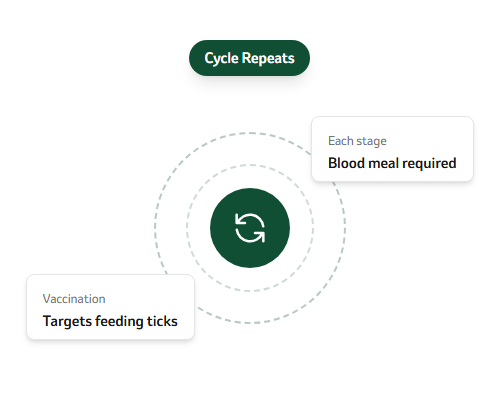
Ticks go through four distinct stages. At each stage that requires a blood meal, the tick is vulnerable to the immune response triggered by NAROVAC.
Egg
Female ticks lay thousands of eggs in sheltered locations — under leaf litter, in soil crevices or on vegetation.
Key fact: A single female can lay 3,000–6,000 eggs. This stage does not involve feeding, so vaccination does not directly target eggs.
Larva
Hatchlings with six legs climb vegetation and wait for a host. They take their first blood meal — essential for development.
NAROVAC impact: When larvae feed on vaccinated cattle, they ingest antibodies that can disrupt their development into the nymph stage.
Nymph
Eight-legged, larger than larvae but smaller than adults. Responsible for transmitting many tick-borne diseases.
NAROVAC impact: Antibodies ingested during feeding can impair the nymph's ability to moult successfully and reproduce.
Adult
The largest stage. Females require a large blood meal to produce eggs. Males feed less but seek females for mating.
NAROVAC impact: Antibodies reduce feeding efficiency, impair egg development and decrease viable offspring — reducing populations over generations.
.webp)
How NAROVAC Targets the Life Cycle
NAROVAC works by training the animal's immune system to recognise and respond to tick proteins. When ticks feed on vaccinated cattle, they ingest antibodies along with the blood.
These antibodies target a protein called subolesin, which is essential for tick feeding, development and reproduction. The effect is cumulative — each generation of ticks that feeds on vaccinated animals is less able to survive and reproduce.
Cumulative Effect
Unlike acaricides that kill ticks on contact, vaccination works through the animal — so the effect builds over time as each generation of ticks is exposed to antibodies.
Key Tick Species in Uganda
NAROVAC is designed to target the most common cattle tick species found in Uganda.
Brown Ear Tick
Rhipicephalus appendiculatus
Primary vector of East Coast Fever. Found mainly in cooler, higher-altitude cattle areas.
Bont Tick
Amblyomma variegatum
Transmits heartwater and dermatophilosis. Common across most of Uganda's cattle areas.
Blue Tick
Rhipicephalus decoloratus
Transmits babesiosis and anaplasmosis. Found in lowland and medium-altitude areas.
Why Understanding the Life Cycle Matters
Knowing how ticks develop helps explain why vaccination is a long-term strategy. For best results, NAROVAC should be used as part of an integrated tick-management approach.